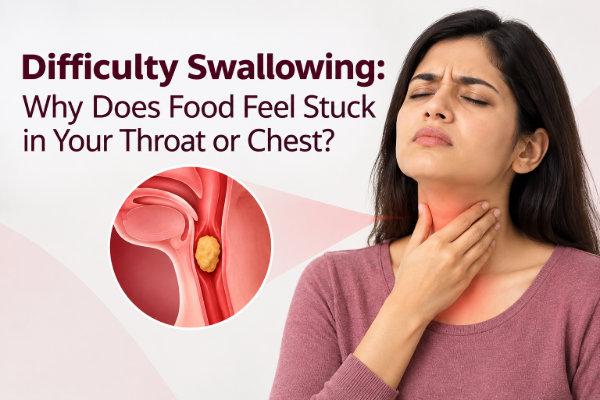
When Eating Becomes Uncomfortable: Understanding the Warning Signs
Swallowing is something most people do without thinking. But what happens when food suddenly feels difficult to swallow, gets stuck in the chest, or seems to take longer than usual to reach the stomach?
Some people experience difficulty with solid foods such as bread, rice or meat. Others struggle with liquids or feel that swallowing does not begin properly. These symptoms may initially be mistaken for acidity, throat irritation or eating too quickly.
The medical term for difficulty swallowing is dysphagia. It can occur because of problems involving the throat, the oesophagus (food pipe), or the coordinated muscle movements that carry food towards the stomach.
Although several causes are treatable, persistent or progressive swallowing difficulty should not be ignored. Understanding the pattern of symptoms can help identify which investigations may be necessary.
What Happens Inside Your Body When You Swallow?
Swallowing involves a coordinated sequence of muscular movements.
First, the mouth breaks food into smaller pieces and mixes it with saliva. The tongue then moves the food towards the throat. Muscles subsequently guide the swallowed material into the oesophagus, where coordinated contractions move it towards the stomach.
Difficulty can develop at different points in this process.
When the problem occurs at the beginning of swallowing, a person may cough, choke or struggle to move food from the mouth into the throat. When the problem involves the oesophagus, swallowing may begin normally, but food can feel as though it has stopped behind the breastbone.
This distinction is important because different underlying conditions may require different investigations.
Four Swallowing Patterns That Deserve Attention
1. Difficulty starting a swallow
Some people struggle to initiate swallowing or feel that food remains in the mouth or throat. Coughing, choking, a wet-sounding voice or food coming through the nose may also occur.
This pattern can be associated with swallowing coordination problems, neurological conditions or disorders affecting the throat muscles.
2. Food getting stuck in the chest
When swallowing begins normally but food appears to stop further down, an oesophageal problem may be responsible.
Possible causes include inflammation, narrowing of the food pipe or abnormal muscular movement.
The perceived location of the blockage does not always identify its actual location, so further assessment may be necessary.
3. Difficulty swallowing solid foods
Difficulty with solid foods while liquids remain easier to swallow can occur when the oesophagus is narrowed.
Potential causes include an oesophageal stricture, inflammation-related changes or another structural abnormality.
This pattern does not establish a diagnosis, but it provides useful information during clinical evaluation.
4. Difficulty swallowing both solids and liquids
When both food and liquids are difficult to swallow, an oesophageal movement disorder may be considered. Achalasia is one example of a condition that interferes with the normal passage of food into the stomach.
Other conditions can produce similar symptoms, making an appropriate diagnostic assessment important.
Six Possible Causes of Dysphagia
Acid reflux and oesophageal inflammation
Gastro-oesophageal reflux occurs when stomach contents flow backwards into the oesophagus. Repeated exposure can irritate the oesophageal lining.
In some people, chronic inflammation may contribute to scar tissue and narrowing, making swallowing difficult.
Heartburn, regurgitation and a sour taste may accompany reflux-related symptoms. However, new or worsening swallowing difficulty should not automatically be attributed to acidity.
Oesophageal stricture
An oesophageal stricture is a narrowing of the food pipe. It may develop following chronic inflammation, injury or other conditions affecting the oesophagus.
Patients may notice that solid food becomes increasingly difficult to swallow. Depending on the severity and underlying cause, endoscopic evaluation may be required.
Achalasia
Achalasia is a disorder in which the lower oesophageal sphincter does not relax normally and the oesophagus has impaired muscular movement.
Food and liquids may accumulate in the oesophagus, causing swallowing difficulty, regurgitation or chest discomfort.
Evaluation may include upper gastrointestinal endoscopy, oesophageal manometry and specialised imaging.
Eosinophilic oesophagitis
Eosinophilic oesophagitis, or EoE, is a chronic inflammatory condition involving eosinophils, a type of white blood cell, in the oesophageal lining.
It may be associated with allergic conditions. Symptoms can include difficulty swallowing solid food and episodes in which food becomes lodged in the oesophagus.
Diagnosis generally involves endoscopy and tissue biopsies.
Food impaction
Food impaction occurs when a swallowed piece of food becomes lodged in the oesophagus.
It can happen in people with an underlying narrowing, inflammation or an oesophageal movement disorder.
If food becomes completely stuck and a person cannot swallow saliva, emergency assessment is necessary. Trying to force the obstruction down with additional food or large amounts of liquid can be dangerous.
Structural abnormalities, including tumours
Some cases of dysphagia result from structural abnormalities involving the oesophagus or nearby tissues. Occasionally, a tumour may be responsible.
Progressively worsening swallowing difficulty, unexplained weight loss, painful swallowing or bleeding should prompt timely medical evaluation.
These symptoms do not automatically indicate cancer, but identifying their cause is important.
When Is Difficulty Swallowing an Emergency?
Certain swallowing problems require immediate medical attention.
Seek emergency care if:
- Food is completely stuck and you cannot swallow saliva.
- You develop choking or difficulty breathing.
- Swallowing suddenly becomes impossible.
- Swallowing difficulty occurs suddenly alongside facial drooping, limb weakness or difficulty speaking.
The last group of symptoms may indicate a stroke.
Persistent or progressively worsening difficulty swallowing, unexplained weight loss, recurrent food impaction or painful swallowing also warrants prompt assessment, even when breathing remains normal.
How Is Dysphagia Diagnosed?
The appropriate investigation depends on the suspected cause and the location of the swallowing problem.
Clinical history and examination
The doctor may ask whether the symptoms affect solids, liquids or both, when they started, whether they are worsening and whether other symptoms are present.
Previous digestive conditions, neurological problems, medication use and episodes of food impaction may also be relevant.
Upper gastrointestinal endoscopy
Endoscopy allows direct examination of the oesophagus and stomach using a flexible instrument with a camera.
It can help identify inflammation, narrowing, suspicious lesions or retained food. Biopsies may be required to investigate conditions such as eosinophilic oesophagitis.
Barium swallow study
A barium swallow uses contrast material and X-ray imaging to assess how material passes through the swallowing system.
It may help identify structural abnormalities or provide information about the movement of swallowed material.
Oesophageal manometry
Oesophageal manometry measures pressure and muscular coordination during swallowing.
It can help diagnose movement disorders such as achalasia when other investigations indicate that further assessment is necessary.
Swallowing assessment
When the difficulty appears to involve the mouth or throat, a specialised swallowing assessment may be appropriate. Depending on the findings, this can include instrumental tests that evaluate swallowing coordination and safety.
Not everyone requires every test. The investigation plan depends on the symptoms and the clinical findings.
Does Dysphagia Always Require Surgery?
No. Treatment depends on the underlying cause.
Reflux-related inflammation may be managed with appropriate medication and other measures. Selected oesophageal strictures can be treated using endoscopic dilation. Achalasia may require a procedure such as pneumatic dilation, myotomy or another suitable intervention.
Some swallowing disorders benefit from specialist swallowing rehabilitation, while other conditions require disease-specific treatment.
Surgery is considered when the underlying diagnosis and clinical circumstances justify it. The aim is to address the cause of the swallowing difficulty rather than treat the symptom in isolation.
What Can You Do While Awaiting Assessment?
If swallowing remains safe, certain practical habits may help reduce discomfort:
- Eat slowly and chew food thoroughly.
- Take small bites rather than rushing through meals.
- Sit upright while eating.
- Record whether symptoms occur with solid foods, liquids or both.
- Note associated symptoms such as heartburn, regurgitation, coughing or weight changes.
- Keep previous medical reports and investigation results available.
These measures do not replace medical assessment. If swallowing is unsafe or food is completely lodged, do not continue eating or attempt to force it down.
Understanding Dysphagia in Hyderabad
Difficulty swallowing can be associated with conditions affecting the throat, oesophagus or upper digestive tract. Identifying the underlying cause may require clinical assessment, endoscopy, specialised imaging or tests of oesophageal movement.
For patients in Hyderabad, including Jubilee Hills and surrounding areas, the appropriate evaluation depends on the symptom pattern and suspected diagnosis.
Dr. G. Rajasekhar Reddy is a Senior Consultant Surgeon at Apollo Hospitals, Jubilee Hills, Hyderabad, with a practice in surgical gastroenterology, general surgery and laparoscopic surgery.
The evaluation of swallowing difficulties may involve collaboration between gastroenterologists, ENT specialists, radiologists and surgical specialists, depending on the clinical findings.
Frequently Asked Questions About Difficulty Swallowing
1. What is dysphagia?
Dysphagia is the medical term for difficulty swallowing food, liquids or both. It can result from problems involving the throat, oesophagus or the muscles and nerves that coordinate swallowing.
2. Why does food feel stuck in my chest?
This sensation can occur with oesophageal narrowing, inflammation or abnormal muscular movement. The sensation alone cannot determine the underlying cause.
3. Can acidity cause difficulty swallowing?
Yes. Reflux-related inflammation can contribute to swallowing problems, and chronic inflammation may sometimes cause narrowing. However, persistent or worsening dysphagia requires appropriate assessment rather than being automatically attributed to acidity.
4. Why can I swallow liquids but not solid food?
This pattern may occur when the oesophagus is narrowed. Other causes are possible, so the symptom should be evaluated in its clinical context.
5. Can stress cause difficulty swallowing?
Stress may contribute to a lump-like sensation in the throat, known as globus. This is different from true difficulty swallowing food or liquids. Persistent dysphagia should not be attributed to stress without appropriate assessment.
6. Which test is best for diagnosing dysphagia?
Upper gastrointestinal endoscopy is commonly used when an oesophageal structural problem is suspected. Depending on the symptoms, a barium swallow, swallowing assessment or oesophageal manometry may also be appropriate.
7. Can difficulty swallowing be treated without surgery?
Yes. Many causes can be managed with medication, swallowing rehabilitation or endoscopic procedures. Surgery may be appropriate for selected conditions, depending on the diagnosis.
8. Is difficulty swallowing a symptom of oesophageal cancer?
It can be, but many other conditions also cause dysphagia. Progressive symptoms, unexplained weight loss or painful swallowing require timely investigation to determine the cause.
9. Which specialist evaluates swallowing problems in Hyderabad?
Depending on the symptoms, evaluation may involve a gastroenterologist, surgical gastroenterologist or ENT specialist. The appropriate specialist depends on whether the suspected problem involves the throat, oesophagus or another part of the swallowing system.
10. When should I seek emergency care for dysphagia?
Seek emergency care if food becomes completely lodged, you cannot swallow saliva, you have difficulty breathing or swallowing difficulty begins suddenly with neurological symptoms.
Conclusion
Difficulty swallowing is more than an inconvenience when it persists, progresses or repeatedly causes food to become stuck.
The symptom can arise from inflammation, narrowing, abnormal muscular movement or other structural conditions. Identifying the cause helps determine whether medication, endoscopic treatment, swallowing rehabilitation or surgery may be appropriate.
Recognising changes in swallowing and arranging timely assessment can help prevent significant underlying conditions from being overlooked.
Dr. G. Rajasekhar Reddy
Senior Consultant Surgeon
Surgical Gastroenterology, General and Laparoscopic Surgery
Apollo Hospitals, Jubilee Hills, Hyderabad


